6:40 on a Sunday evening in August, backyard, grill running at full heat with the lid open, and I'm holding barbecue tongs in my right hand like the world's least dangerous surgeon. On the grate sit two pieces of steel. One is my stack of hand-stamped stainless washers on a bolt. The other is my brother-in-law's commercial backup plate, the kind that costs $180 in the outdoorsy catalogs, lent to me expressly because he was sure it would win. Inside my house is a wallet worth about $9,300 whose whole existence depends on twelve words surviving a bad night. The grill and I had plans for the next twenty minutes.
The stakes deserve plain language. A hardware wallet stores keys, but the twelve words are the actual money; anyone holding them owns the $9,300, and nobody holding them means the $9,300 is decorative forever. Paper copies burn, and houses do burn, which is why the metal backup exists as an idea. My version costs less than a dinner. His costs four of my dinners. What we were honestly testing on that grate was whether $142 of retail packaging changes how letters behave in a fire.
The result embarrassed exactly one of us, and it wasn't me. Twenty minutes at temperature settled the question, the tongs did the interview afterward, and a concrete step held the press conference. What surprised me wasn't that steel survives a grill, because steel evidently survives a grill, and nobody involved was under any illusion about metal melting. It was which letters survived best, and why, and what that says about the difference between buying preparedness and building it. The full protocol is below, including the part where I stamped a decoy phrase instead of the real words, because you never run a test with the actual keys. Never once. That rule has no exceptions worth the risk.
$0.65 a washer and a $14 stamp set
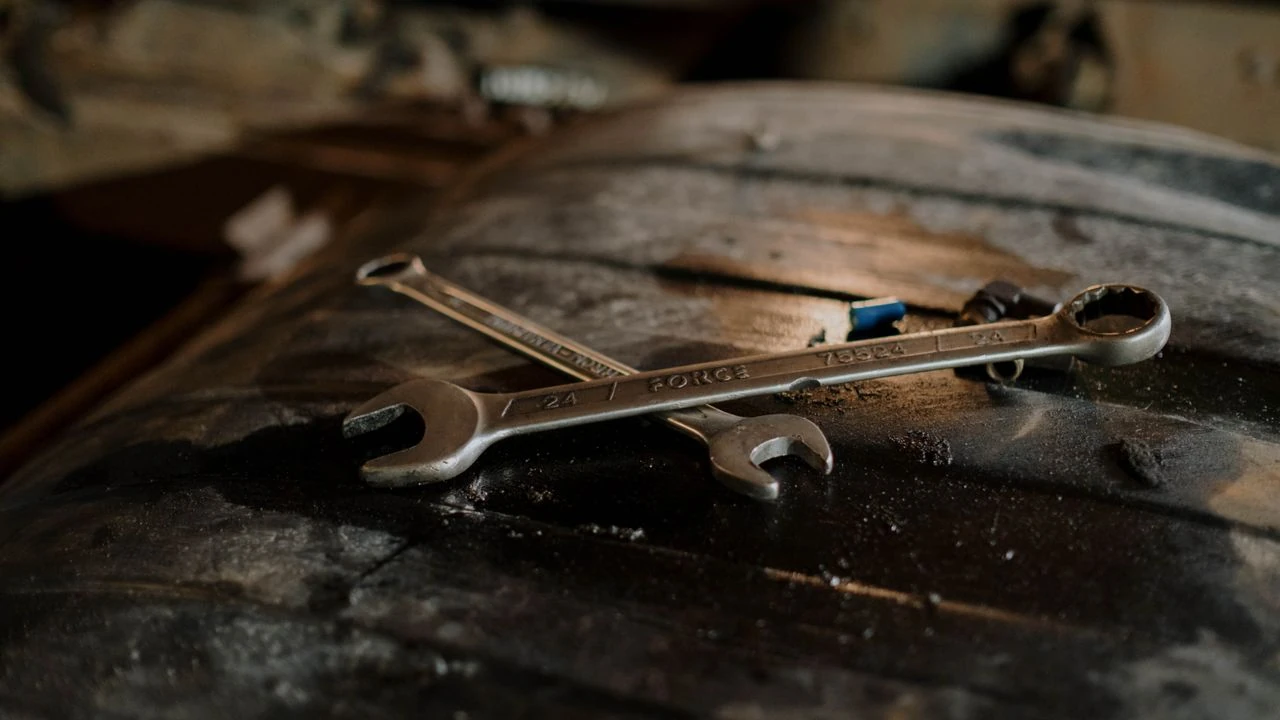
The cheap rig, itemized, because the number gets quoted alot online and rarely shown. Fourteen large fender washers in 316 stainless, the marine-grade stuff, $0.65 each at the hardware counter where the clerk asked if I was making jewelry, and the answer was technically no. A 3-millimeter letter-and-number stamp set, $14 on sale. A slight ball-peen hammer I already owned, counted as $0, and a bench block scrap from the offcut bin, likewise. One stainless bolt and two nuts to stack the washers, $2.40. Total damage: $38.40 in parts and about ninety minutes of slow tapping at my kitchen table with a towel underneath to keep the neighbors sane. Every stamp hit twice. Deep, slow strikes beat fast shallow ones, same as most things.
the decoy phrase, stamped on purpose
Here's the part most tutorial videos skip, and it matters more than the stamp set. The washers I tested were stamped with a decoy, twelve real English words pulled semi-randomly from a novel on my shelf, arranged into a phrase that looks like a seed but opens nothing. The actual backup lives elsewhere, stamped separately, on a different evening, and it has never been photographed, scanned, or typed anywhere. Practicing on the real thing is how people end up guarding a photograph of their life savings. Practice material costs $0.65 a washer. Mistakes cost $9,300. The arithmetic there doesn't need a spreadsheet.
twenty minutes at full flame
The protocol, such as it was. Both stacks went onto the grate at 6:47 PM, directly over the coals, with a grill thermometer reading about 600 degrees at grate level, give or take the wind. Twenty minutes, lid open, flipping each piece with the tongs at the ten-minute mark like they were unfortunate sausages. The washers went rainbow-striped from heat tint, blue and gold at the edges, which is just oxidation doing its thing. The commercial plate darkened evenly, all business. No household grill is a house fire, fair, but twenty minutes of direct flame is a more honest test than a kitchen sink, and its the test I could actually run. Smoke counts as peer review.
a caliper and a grudge
The Thursday before the test, I measured both stamps with a $22 digital caliper, cuz claims about depth are cheap and calipers cost twenty-two dollars and tell the truth. My washer grooves: 0.7 millimeters deep, give or take the wobble of a hand-held hammer. The factory etching on the borrowed plate: 0.3 millimeters, uniform, tidy, and visibly less than half as deep. Nobody advertises that number, and to be fair the plate was never marketed as the deepest stamp in the world, just the most convenient. Convenience is a fine product. Fire, it turns out, grades on depth.
two faded letters on a $180 plate
The verdict came off the grate at 7:03 PM after a short cooling period on the concrete step, carried the whole way with tongs and no bare hands. My washers: every letter crisp, edges softened by discoloration only, all twelve decoy words readable without squinting. The $180 plate: twenty of its factory-etched characters fine, but two of them, an E and a 4, had gone noticeably shallower, the stamped grooves partially smoothed as if the fire had taken a light sandpaper to exactly those spots. Readable, still. Barely debatable. My hand-stamped grooves ran about twice as deep as the factory etching, and depth turned out to be the whole ballgame. The brother-in-law took the news the way people take news about their favorite brand.
$142 of difference, one envelope
The price gap deserves its own arithmetic. $180 minus $38.40 is $141.60, call it $142, and that money stayed in my envelope system instead of a shopping cart. My emergency fund lives in high-yield savings at 4.10 percent, and the tool envelope tops up from it twice a year; $142 left in that account is $142 earning its quiet four percent and available for a genuine emergency, like an actual furnace. A backup plate is a worthy product. It just isn't $142 worth of worthy in a driveway where a hammer already lives. Your mileage may differ if your hammer skills end at hanging pictures.
the rule about tools under $500
While we're on envelopes, here's the rule that made the washer rig automatic. Anything under $500 comes out of the tool envelope as cash, no installment plans, no BNPL apps, and certainly no personal loan for a piece of steel, which I once saw a coworker arrange for a $600 drone and regret at every statement. Financing a fireproof backup with borrowed money has a smell to it. Preparedness financed at interest is a subscription to worry. The $500 line is arbitrary. Most good rules are.
nine months at 22
Why the rule is strict has a year attached: my 22nd. I financed a $400 tool set on a payment plan that was supposed to take three months and took nine, with fees that turned $400 into $452, and the box outlived my interest in the trade by about a season. The lesson wasn't about tools. Debt on depreciating stuff is paying tomorrow's self for today's impulse, and tomorrow's self has never once thanked me for it. That's the entire financial philosophy I've got. It fits on a postcard and it saved me $142 on a Sunday.
a bolt, two locations, no photos
Practical notes for anyone copying this, cuz a backup you can't retrieve is a rumor. The washers thread onto a stainless bolt with two nuts, tightened into one dumb solid bar. One bar lives in a fire-rated safe at home. The second bar lives at my sister's house, 40 minutes away, because a house fire that takes both copies of a document is a house fire that also took the whole neighborhood. Nothing gets photographed. Nothing gets typed. The decoy washers from the test? Recycled into the junk drawer, holding nothing but their secrecy. Storage is half the system. The stamping is the easy half.
back to the tongs
By 7:20 PM the grill was doing what it was built for, salmon fillets, and the two pieces of steel sat cooling on the step like witnesses after testimony. The washers went back on their bolt. The plate went back in its box, and its owner went home with a grudging sentence I'll treasure: yours are deeper. That's the whole finding, one Sunday, $142 kept in high-yield savings, zero letters lost, and a slight permanent suspicion of anything sold in foam packaging. Six-forty next Sunday the grill will light again for dinner, not for metallurgy. If a hot ember ever finds this house, the twelve words will be waiting on a bolt, exactly as deep as a hammer and an evening could make them.